Heavy-Lift Drone Batteries: LiPo, Li-ion and Solid-State
On a heavy-lift or long-endurance UAV the battery is usually the heaviest single item on board and the most expensive consumable. Choosing one means balancing three things: how much energy it carries per kilogram, how much current it can deliver to large motors, and how you will charge, store and move packs that each hold several hundred watt-hours.
Energy density: the number that sets endurance
A pack's energy is its nominal voltage times its capacity in amp-hours. A 6S 22,000 mAh pack is 22.2 V x 22 Ah, about 488 Wh. Divide by the pack's weight and you get its energy density in Wh/kg: if that pack weighs 2.6 kg, it carries roughly 187 Wh/kg.
Energy density matters because a multirotor spends almost all of its power simply staying in the air, and every kilogram of battery has to be lifted too. Adding capacity of the same chemistry adds weight in the same proportion, so flight time grows more slowly than the battery does, and at some point it stops growing at all. A chemistry with more Wh/kg raises that ceiling: for the same battery weight it gives more energy, without asking the motors for more thrust.
When comparing packs, work out Wh/kg yourself from the nominal voltage, the capacity and the weight on the scale, rather than trusting the number in the product name. Check too whether a figure refers to the bare cell or the finished pack: the case, wiring, balance board and any electronics add weight, so pack-level figures are always lower. The FPV.BASE flight time calculator shows in advance how a given pack's weight and energy affect hover current and flight time.
LiPo, Li-ion and semi-solid packs
Three families of battery are used on large UAVs, and each suits a different kind of aircraft:
The figures vary between makers and models, so read them as ranges, not rules. The more energy a cell is designed to hold, the less peak current it usually delivers, and that trade-off runs through every decision in this guide. The basic differences between LiPo and Li-ion are covered in the LiPo vs Li-ion guide; this one is about large packs.
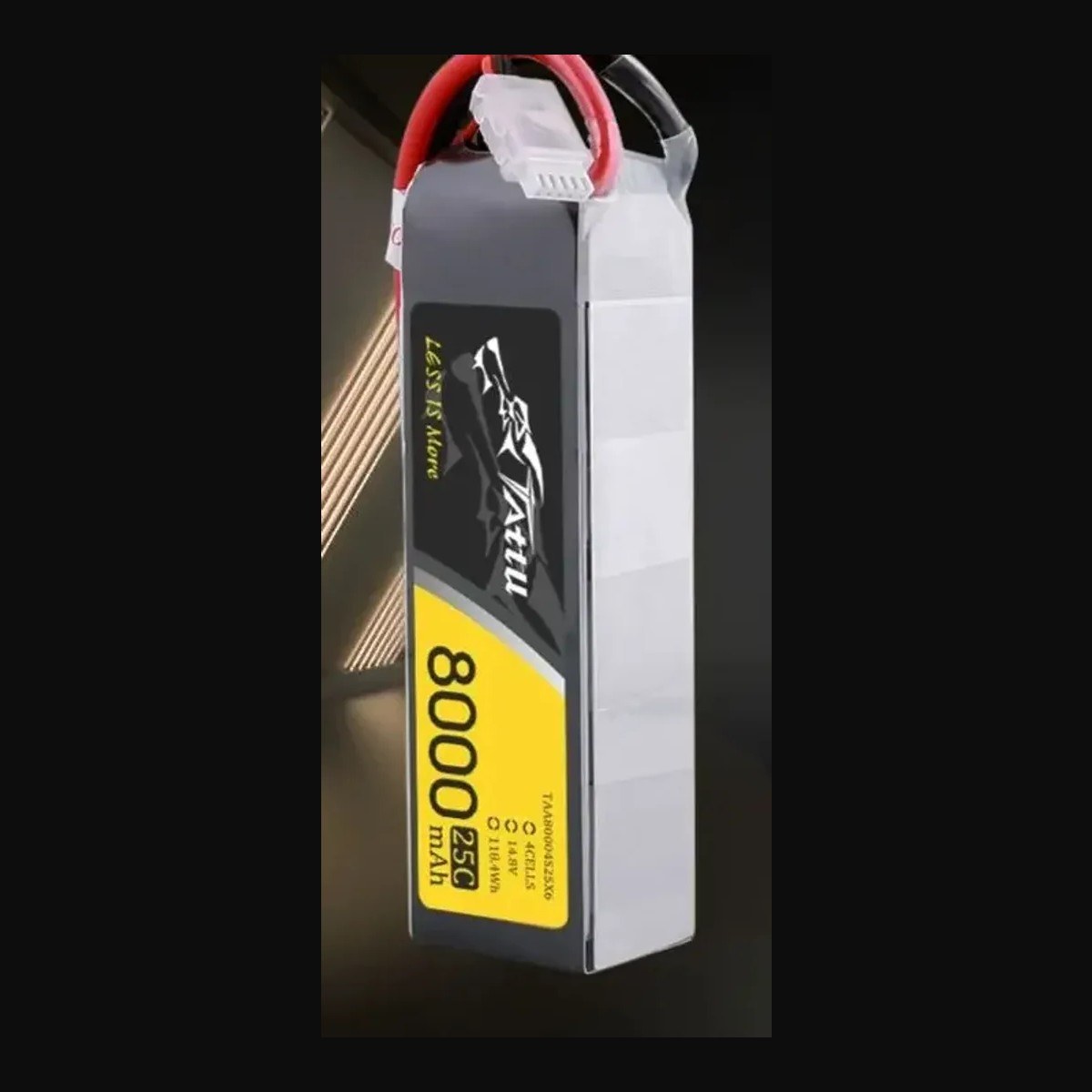
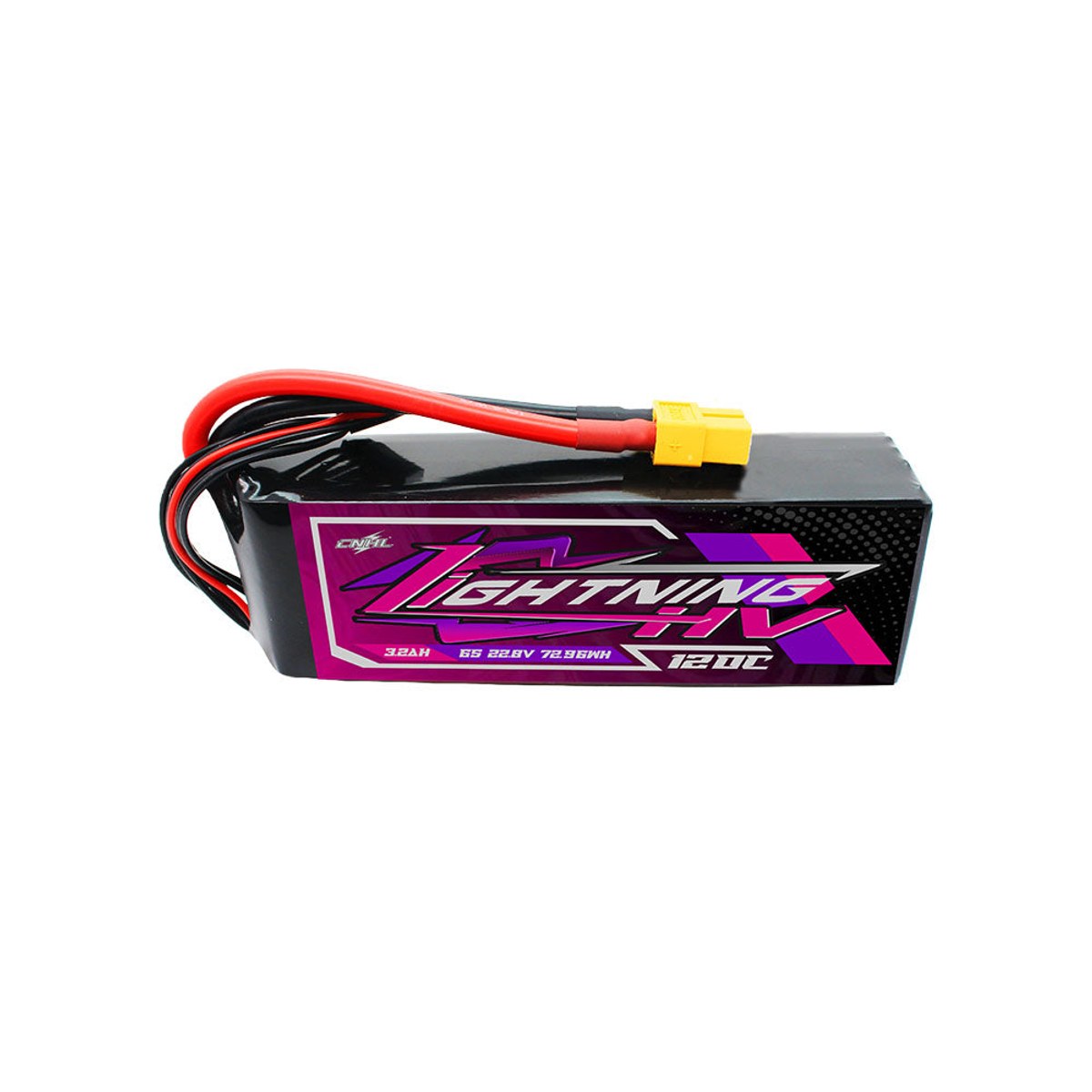
- LiPo: roughly 150 to 200 Wh/kg in large drone packs, with high continuous and burst current. Suits heavy-lift multirotors, spraying drones and any aircraft that needs strong current for take-off, wind or a heavy payload.
- Li-ion packs built from cylindrical cells (18650, 21700): typically around 200 to 260 Wh/kg at pack level, with lower current. Suits efficient cruising: fixed-wing, VTOL in forward flight, and light, efficient multirotors.
- Semi-solid pouch packs, often sold as solid-state: commonly marketed at around 280 to 350 Wh/kg, with moderate current. Suits mapping, inspection, VTOL and long-endurance missions where flight time comes first.
What "solid-state" means on a drone battery today
In a conventional lithium battery, ions travel between the electrodes through a liquid electrolyte. A true all-solid-state battery replaces that liquid entirely with a solid electrolyte. That technology is still largely at the development and early-production stage, and it is not what most drone packs labelled solid-state contain.
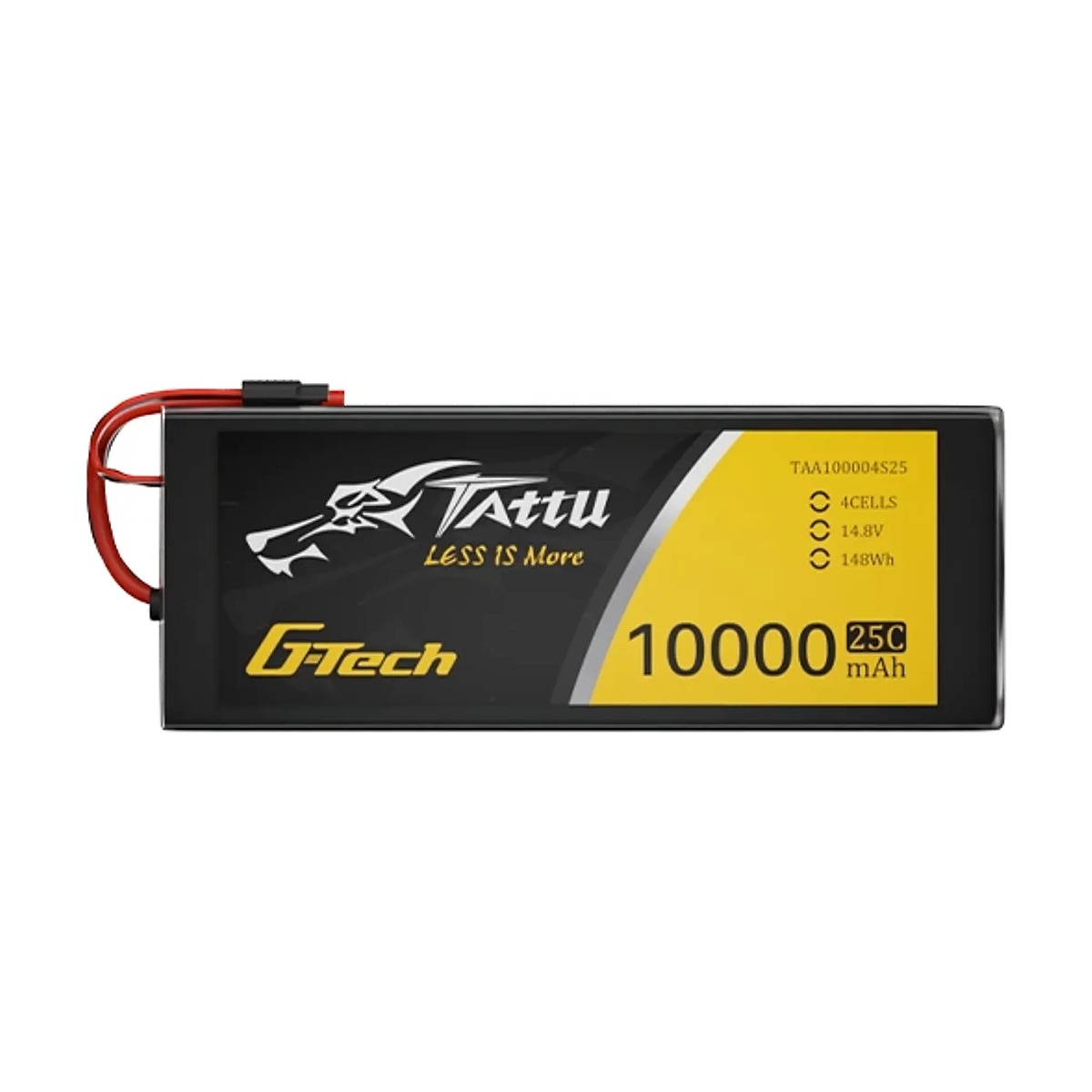
Most commercial UAV packs sold as solid-state are semi-solid: they keep part of the electrolyte as a liquid or gel, alongside solid electrolyte materials, usually with a high-nickel cathode and a silicon-containing anode. Makers such as Grepow, which produces Tattu batteries, describe their own lines as semi-solid state. The result is a lithium-ion pouch cell with clearly higher energy density than LiPo, and makers claim long cycle life and good behaviour in the cold.
In practice, treat a semi-solid pack as a high-energy lithium-ion battery. It still needs a balance charger, correct voltage limits and the same fire precautions as any lithium pack. Read its datasheet for the full-charge voltage per cell, the continuous and peak current, and the recommended charge rate, because all three differ from LiPo and from one maker to the next. Some packs use high-voltage cells that charge to 4.35 or 4.4 V per cell; others stop at 4.2 V.
C rating against what large motors really draw
The C rating times the capacity in amp-hours gives a current: a 22 Ah pack rated 20C is 440 A on paper. Rather than stopping there, work out what your aircraft actually draws. Hover power divided by battery voltage gives hover current: a drone that needs 3 kW to hover draws about 68 A on 12S (44.4 V nominal), and would draw about 135 A on 6S. In climbs, gusts and manoeuvres the peaks can reach two to three times the hover current or more, depending on the thrust-to-weight ratio.
High-energy packs are usually rated far lower than LiPo, for example 3C, 5C or 10C, and some makers allow the full rating for only a few seconds at a time, with a lower figure for continuous use. Read the continuous figure and make sure it sits well above your hover current, with margin for the peaks. A pack working near its limit sags in voltage, heats up and ages faster.
If one high-energy pack cannot supply the current, a second identical pack in parallel halves the current each one delivers. For aircraft that hover heavily loaded for most of the flight, LiPo is often the better fit.
6S, 12S, 14S: voltage, series and parallel
Large aircraft run on high voltage because power is voltage times current. Double the voltage and the current halves for the same power, while losses in wires, connectors and ESCs fall with the square of the current. That is why heavy-lift multirotors and agricultural sprayers commonly run on 12S or 14S, while smaller industrial and VTOL airframes often use 6S or 7S.
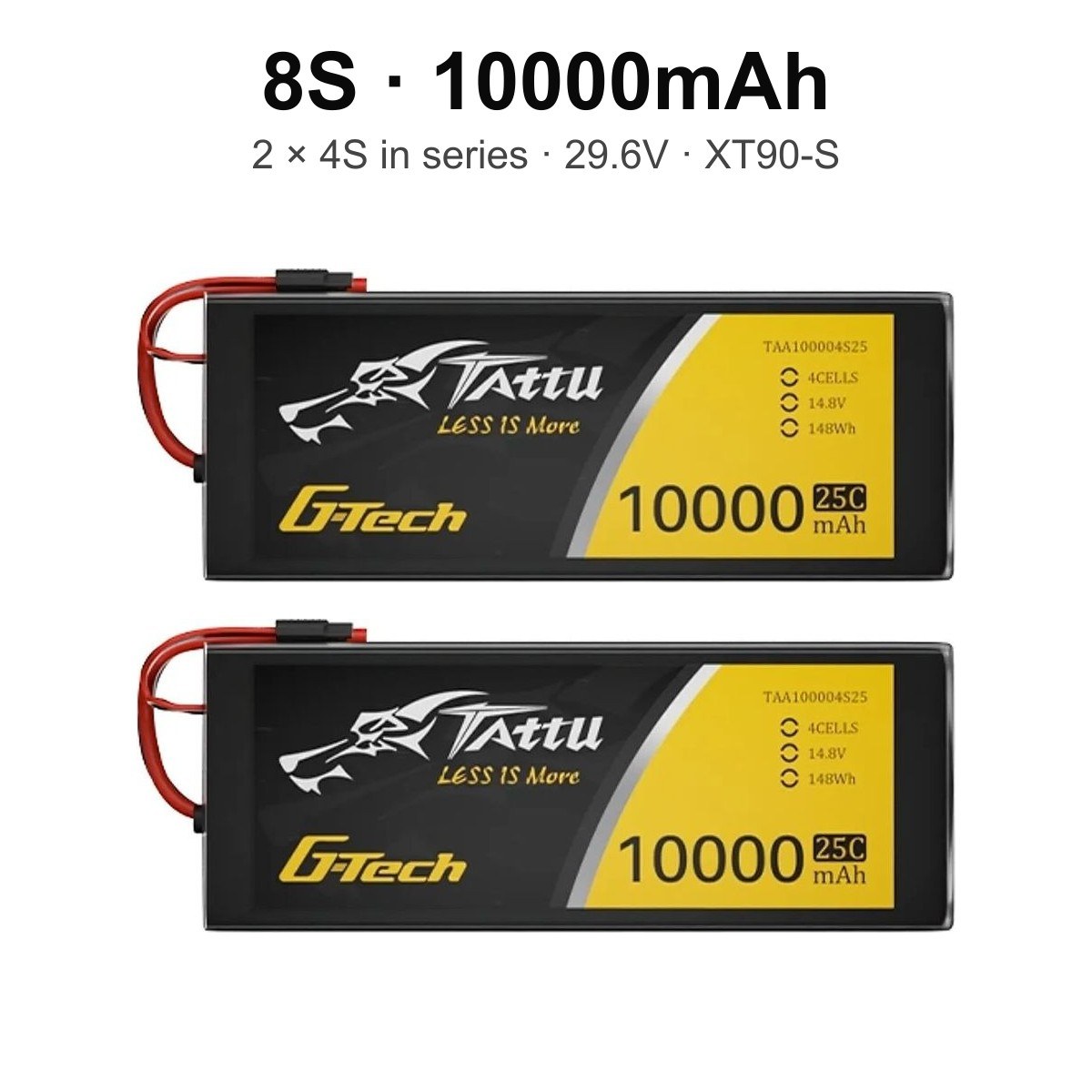
The label tells you how a pack is built: 6S1P is six cells in series, and 6S2P is two such strings in parallel, giving double the capacity at the same voltage. Two identical 6S packs connected in series make 12S; connected in parallel they make a 6S pack of double the capacity.
Packs joined in series or parallel must be the same model, capacity and age, and at the same charge level before you connect them. Mismatched packs drift apart: in series the weaker pack is driven lower than its partner, and in parallel the fuller pack dumps current into the emptier one the moment they meet. Charge each pack through its own balance lead, and check that every component, including the ESCs, power module, BEC, servos and payload, is rated for the full-charge voltage of the combined system: 50.4 V on 12S and 58.8 V on 14S.
Connectors and wiring for big packs
At hundreds of amps and 50 V or more, the connector is a safety part. Large packs commonly use the XT90-S, XT150, AS150U, QS8, QS10 or similar, most of them anti-spark designs, because the spark when plugging into large ESC capacitors grows with voltage. Go by the maker's continuous rating at a stated wire gauge, not by the number in the connector's name, and size the wire for the current.
Use one connector type across the fleet and keep adapters for the bench, not for flight. In a series setup the series lead is part of the power path as well, so it needs the same current rating as the main connector. Ratings, anti-spark designs and soldering are covered in detail in the battery connectors guide.
Charging large and smart packs
Charging power is voltage times current. A 12S 30 Ah pack charged at 1C takes 30 A at up to 50.4 V, about 1.5 kW per pack, so field charging for a fleet needs chargers in the kilowatt range and a mains circuit or generator that can carry them. A 3 kW charger draws close to what a single household socket can supply, so check the circuit before running one at full power.
Set the charger to the right chemistry and full-charge voltage per cell. A LiPo profile on a high-voltage pack leaves it undercharged; a high-voltage profile on a standard pack overcharges it, which is dangerous. Many high-energy packs specify a gentle charge rate, sometimes 0.2C to 1C, so a bigger charger does not always mean a faster charge.
Smart batteries carry a battery management system (BMS) that reports cell voltages, temperature and cycle count, and some discharge themselves to storage level after a few days unused. A matching smart charger reads that data and chooses the parameters itself. With a non-smart pack you set the type, cell count and current by hand on every charge, so label each pack clearly.
Storage, transport and shipping
Store large packs at storage voltage, around 3.8 V per cell for LiPo, or at the level the maker specifies for Li-ion and semi-solid packs, somewhere cool and dry, in a fire-resistant container. Do not leave them in a car in the sun, and check their voltage every few weeks.
To be shipped at all, lithium batteries must have passed the UN38.3 transport tests, and a reputable maker supplies the test summary and a safety data sheet. The watt-hour figure decides how a pack may travel by air:
In practice, plan to move large packs by road or through a specialist dangerous-goods shipper, and to buy them close to where you fly. FPV.BASE ships lithium batteries by ground courier only.
- Up to 100 Wh: allowed in passenger carry-on baggage, usually without airline approval
- 100 to 160 Wh: carry-on only with airline approval, normally no more than two spares
- Above 160 Wh: not allowed in passenger baggage at all, and almost every heavy-lift pack is in this group
- As air cargo, a stand-alone lithium-ion battery above 100 Wh is Class 9 dangerous goods, cargo aircraft only, at no more than 30% state of charge
Lifecycle: tracking packs and knowing when to retire them
Give every pack a number and log its cycles, its voltage after charging and the energy each flight used. Many chargers and battery checkers also show internal resistance: a rise compared with sister packs, or cells that finish charging more than about 0.1 V apart, means the pack is ageing.
Cycle life depends heavily on use. Moderate current, landing with reserve and storing at the right voltage all extend it; deep discharges, heat and high current shorten it. Makers' cycle figures, such as semi-solid packs claimed to keep 80% of their capacity after more than a thousand cycles, are measured in laboratory conditions, so treat them as a ceiling. A common practice is to retire a pack from critical flights once it holds around 80% of its original capacity, and immediately if it swells, is damaged or runs unusually hot.
How long will your drone fly?
Pick a motor, prop and battery, and get an estimate of weight, current, flight time and thrust-to-weight ratio.
Open the flight time calculator →