ELRS 868/915 MHz vs 2.4 GHz: Which Receiver to Choose?
ExpressLRS (ELRS) is an open-source radio link for FPV that comes in two flavours: 2.4 GHz, and sub-GHz at 868 or 915 MHz depending on region. They share firmware and configuration, but they behave differently in the air.
2.4 GHz: fast and compact
2.4 GHz gives the lowest latency and the highest packet rates, up to several hundred hertz and beyond on suitable hardware, which makes sticks feel immediate. Antennas are short and light, and the band is usable in most countries.
The trade-off is range and crowding. 2.4 GHz shares its band with Wi-Fi and other devices, and it loses more energy through obstacles such as trees, buildings and terrain, so the same transmit power reaches less far than it does on sub-GHz.
868/915 MHz: range and penetration
Lower frequencies pass through obstacles and foliage better and lose less over distance, so a sub-GHz link usually reaches further at the same power. That is why it is the usual choice for long-range and mountain flying.
The trade-offs are lower maximum packet rates, about 200 Hz, slightly more latency, and longer antennas. The permitted band and transmit power differ between countries, so check the rules where you fly before you choose 868 or 915 MHz.
Diversity, Gemini and dual-band receivers
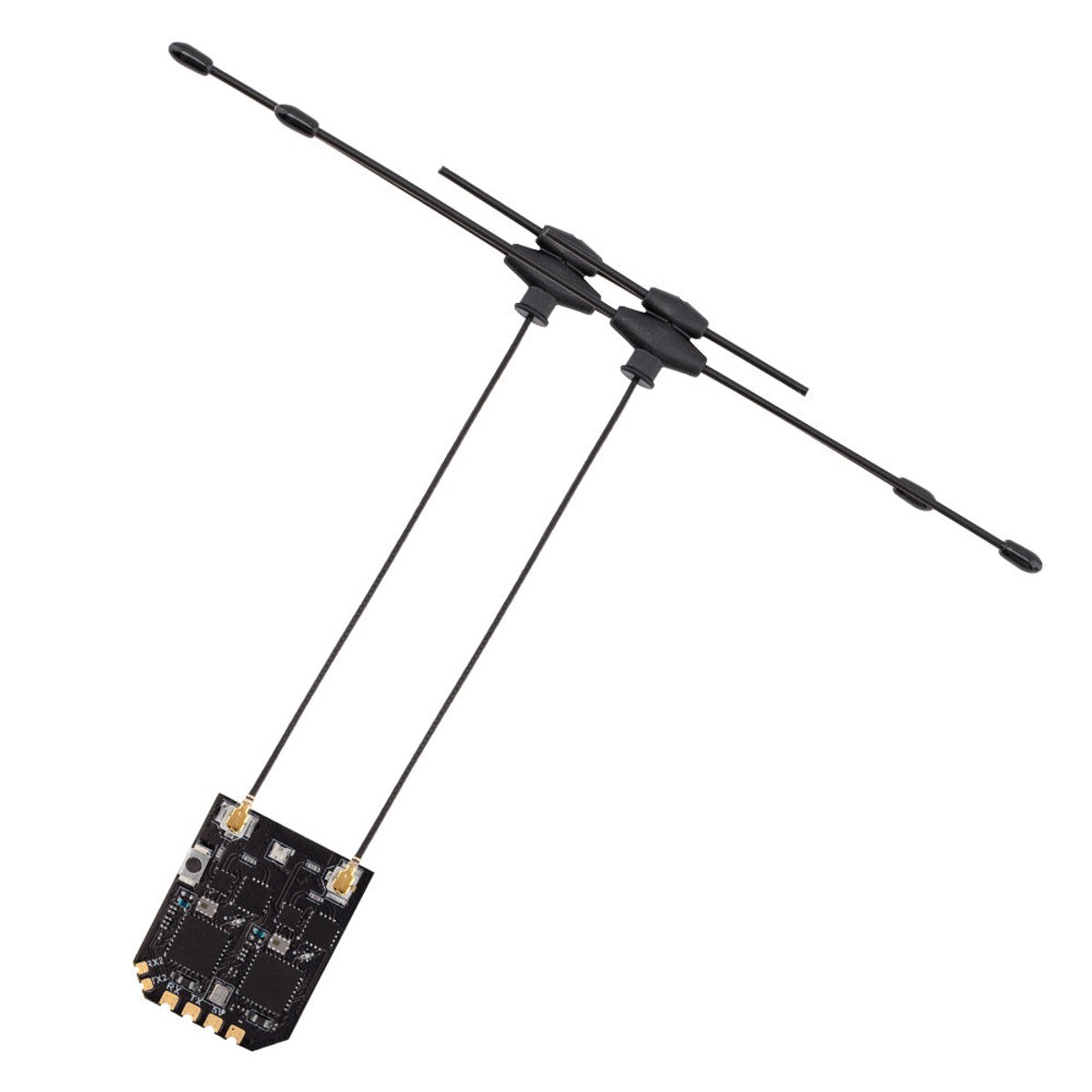
Two antennas make a link more robust, because when one is shadowed by the airframe the other still hears the radio. True Diversity receivers use two radio chips, one per antenna, and pick the better signal. Gemini receivers go further and use both chips at once for a steadier link.
Dual-band receivers built around the LR1121 chip can run both bands. In the cross-band mode one antenna works on sub-GHz while the other works on 2.4 GHz, at the same time, so the link keeps working if either band is disturbed.
Your radio must match
The receiver and the transmitter module in your radio must use the same band. A 2.4 GHz receiver will not talk to a 868/915 MHz module, and the reverse. Dual-band modules exist too, and are the way to use a dual-band receiver in both bands.
Keep the ExpressLRS major version the same on both ends (for example 3.x with 3.x), and bind with the same phrase. Telemetry, such as battery voltage and GPS position, comes back over the same link.
Which should you choose?
- Freestyle, racing and short-range cinematic flying: 2.4 GHz
- Long range, mountains, forests and flying behind obstacles: sub-GHz 868/915 MHz
- Both styles, or you are not sure yet: a dual-band setup, on both the receiver and the radio module
Antenna tips
Use the antenna made for your band: sub-GHz antennas are longer than 2.4 GHz ones. Keep antennas clear of carbon fiber, which blocks radio, and away from the video transmitter's antenna. With two antennas, mount them at an angle to each other rather than parallel.